As the primary gateway to the Annapurna region, Pokhara offers access to more than 60 distinct trekking routes. Among them, the top 5 short treks include Ghorepani Poon Hill, Short Annapurna Base Camp, Annapurna Base Camp, Khopra Danda, and Mardi Himal Trek. These routes allow you to experience the Himalayas in under a week. You don’t have to commit to long, demanding expeditions for big mountain views, local teahouse stays, and varied terrain.
The trails range from easy cultural walks through terraced villages to steeper alpine climbs near the tree line. If it’s your first trek, Ghorepani Poon Hill is the easiest entry point. Similarly, if you want better scenery without pushing too hard physically, Mardi Himal is the stronger choice as it leads you closer to peaks like Machhapuchhre and Dhaulagiri without heavy crowds.
Best Short Treks from Pokhara at a Glance
| Trek | Duration | Max Altitude | Difficulty | Typical Cost (HC Treks) | Best For | Key Highlight |
|---|---|---|---|---|---|---|
| Ghorepani Poon Hill Trek | 5 Days | 3,210 m (Poon Hill Viewpoint) | Easy | $530-$1195 | Beginners and families | Iconic sunrise views over the Annapurna and Dhaulagiri ranges |
| Short Annapurna Base Camp | 5 Days | 4,130 m (ABC) | Challenging | $525-$1195 | Fit hikers short on time | Fast-track route into the Annapurna amphitheater |
| 7 Days Annapurna Base Camp | 7 Days | 4,130 m (ABC) | Moderate | $650-$1390 | Classic scenery lovers | Balanced pace with hot springs and a full base camp experience |
| Mardi Himal Trek | 7 Days | 4,042 m (Upper Viewpoint) | Moderate | $555-$1220 | Crowd-avoidant trekkers | Quiet ridges with close-up Machhapuchhre views |
| Khopra Danda Trek | 6 Days | 4,665 m (Khayar Lake) | Moderate | $590-$1295 | Off-the-beaten-path explorers | Community lodges and an optional sacred Khayar Lake hike |
Note: The package cost depends on the group size. The larger the group, the lower the price.
5 Days Ghorepani Poon Hill Trek at $1195
Ghorepani Poon Hill Trek is the most beginner-friendly trek around Pokhara, but don’t mistake “easy” for “forgettable.” The trail moves through terraced fields, rhododendron forests, and traditional Gurung and Magar villages like Ghandruk and Tadapani before reaching Poon Hill at 3,210 m in just five days.
The main highlight is the sunrise hike from Poon Hill Viewpoint. You will watch the massive faces of the Annapurna range, Dhaulagiri, and Machhapuchhre slowly light up in layers of gold and snow—an experience that feels incredibly quiet, cold, and beautifully surreal. Then, on the way back, Jhinu Danda offers natural hot springs, which honestly feel like a reward you didn’t know you needed.
Because the altitude stays manageable and the walking is steady rather than intense, this is the safest recommendation for beginners. Families, older trekkers, or anyone wanting a real Himalayan experience without pushing physical limits will find this route perfectly balanced.


5 Days Short Annapurna Base Camp Trek at $1195
This is the quickest way into the Annapurna Sanctuary, covering the same destination as our classic 7-day ABC Trek on a tighter, more demanding schedule. The key difference is the starting point. Instead of the gradual approach through Ghandruk, the route begins with a direct drive from Pokhara to Jhinu Danda, followed by a climb from Sinuwa. That alone cuts a full day from the journey and sets a faster pace from the start.
From Sinuwa, the trail rises steadily through bamboo and rhododendron forest, gradually shifting into steeper, more rugged terrain. It passes the last major teahouse stop at Deurali before entering the high-altitude riverbed section, which can feel exposed and demanding, especially during peak snowmelt or unstable conditions. From there, it pushes upward to Machhapuchhre Base Camp at 3,700 m and finally reaches Annapurna Base Camp at 4,130 m on day three of the trek itinerary.
Once you step into the Sanctuary, everything opens up at once. Annapurna I, Annapurna South, Hiunchuli, Gangapurna, and Machhapuchhre form a full circle around you. Photos and videos only show you the trailer. Here, you get the full movie, where the real size of the mountains reminds you how small you are.
The trade-off is intensity. The shorter itinerary means you need to walk for longer hours (6 to 8 hours) daily and face a steeper rate of altitude gain of nearly 1,000 meters on the most challenging trekking day. You need decent fitness and some prior trekking experience to tackle this. It’s not suitable for complete beginners, but for prepared trekkers working within a five-day window, it delivers the full ABC experience without compromise.
6 Days Khopra Danda Trek at $1295
This trek avoids the busy Annapurna corridors and instead follows quieter ridgelines that most visitors never reach. Starting with a drive to Ghandruk, the route climbs through forests and alpine terrain, passing Tadapani and Bayeli Kharka, and continues to Khopra Ridge at 3,660 m.
From the ridge, the view is wide and uninterrupted. The panorama of Annapurna, Dhaulagiri, Nilgiri, and Machhapuchhre stretches across the horizon without the usual crowds in the foreground. Nearby lies Khayar Lake at 4,665 m, a high-altitude lake tucked beneath two giants: Annapurna South and Bhara Shikhar (Annapurna Fang). The side-trip to the lake requires a demanding 4 to 5-hour hike each way from the ridge, meaning a total round-trip of 8 to 9 hours—but the stark alpine scenery is absolutely worth the effort. Plus, it adds a more demanding, almost spiritual layer to the journey, changing how the whole experience feels.
It is a less commercial, more grounded trek route. You stay in community-run lodges that directly support local villages throughout the trek. So, if you’ve already done Poon Hill or ABC or ABC via Poon Hill, or just want something quieter and more authentic, this route will give you exactly what you’re looking for.


Annapurna Base Camp Trek at $1390
The ABC Trek is the most well-rounded version of the Annapurna Base Camp trek. It follows a similar route through forests, terraces, and Gurung villages, gradually rising into the Annapurna Sanctuary. Here, Machhapuchhre Base Camp steals the spotlight for some time before the ultimate destination, Annapurna Base Camp, takes it back. The V-shaped valley of MBC changes into a literal 360-degree natural amphitheater, surrounded by Annapurna I, Annapurna South, Gangapurna, Tent Peak, Hiunchuli, and Machhapuchhre.
Compared to the shorter itinerary, this version gives you space to breathe. The ascent feels more natural, and the altitude is easier to handle. You get enough time to actually take in the scale of the mountains instead of rushing past them. On the way back, a stop at Jhinu Danda’s natural hot springs adds a slow, grounding finish to the trek. This route also bypasses the brutal return climbs to Ghandruk, making the descent noticeably easier on tired legs.
Mardi Himal Trek at $1220
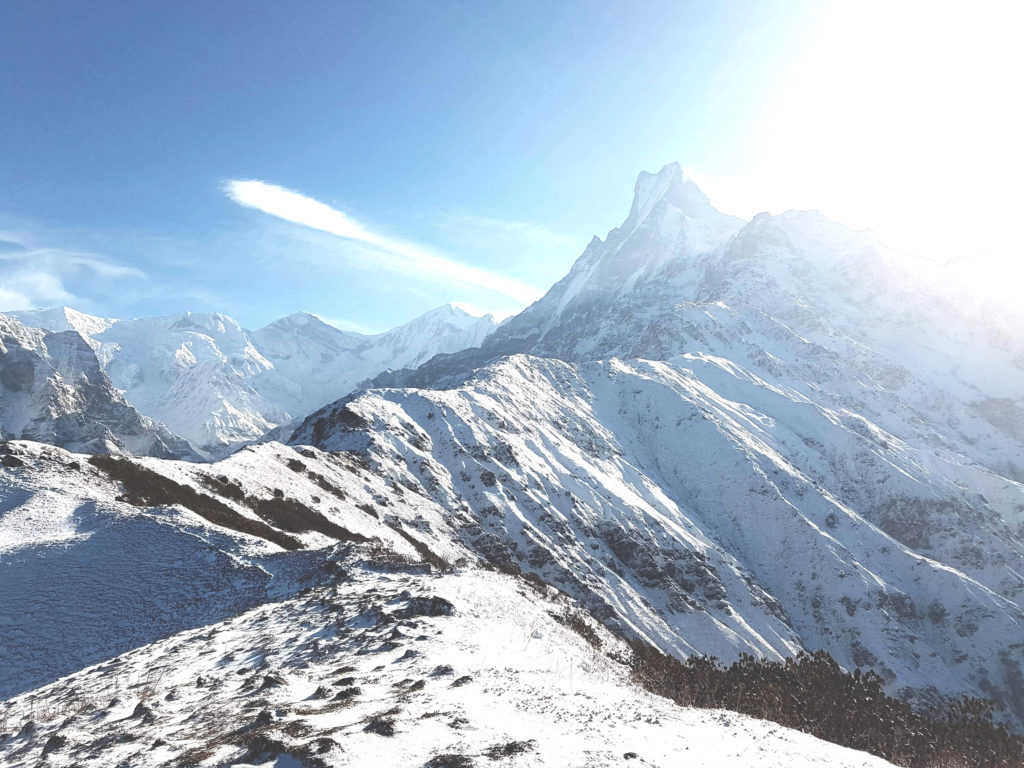
The Mardi Himal Trek is a ridge trail on the eastern side of the Annapurna range that offers some of the closest, most direct views of Machhapuchhre (Fishtail). The route starts with a drive from Pokhara to Sidding, climbs immediately through dense forest to Low Camp, and continues up to High Camp before making the final push to the Mardi Himal Viewpoint at 4,042 m.
At the upper viewpoint, the mountains no longer feel far away or separate. Annapurna South, Hiunchuli, and Machhapuchhre rise almost straight out of the ground in front of you, filling the entire frame of your vision. Standing in the crisp alpine air, surrounded by massive walls of rock and ice, everything inside you goes quiet.
The trail itself stays peaceful, with smaller teahouses and slower days. The descent along the scenic ridgeline of Badal Danda, down to villages like Landruk, adds a cultural layer shaped by the Gurung and Magar communities towards the end of the trek. The pace stays balanced, manageable for beginners, but long enough to feel like a real journey, not just a short escape, even on a limited budget.
How to choose between them
Not sure which trek fits your timeline, fitness, and experience? Here’s a quick guide to help you match your situation to the right trail without overthinking it:
| Trek | Choose if… |
|---|---|
| Ghorepani Poon Hill | You want a short and easy trek for your first Himalayan experience, have limited trekking experience, or are traveling with family. |
| Mardi Himal | You want dramatic mountain views, are comfortable with steeper trails, and want a moderate challenge. |
| Khopra Danda | You prefer quieter trails and have already completed the popular trekking routes in Nepal. |
| Short Annapurna Base Camp (5 Days) | You want to reach Annapurna Base Camp as quickly as possible and are comfortable with longer, more strenuous trekking days. |
| Annapurna Base Camp (7 Days) | You want the full ABC experience at a comfortable pace with better acclimatization and more time in the Sanctuary. |
Best Time for Short Treks Around Pokhara
The best times to trek in Nepal fall into two peak seasons: autumn and spring. Autumn, especially October and November, brings post-monsoon clarity. Similarly, Spring, around March and April, shifts the landscape in the opposite direction, warmer air, softer light, and rhododendron forests bursting into color along the trails.
Spring (March-May) – Flowers and Stable Skies
- The vibe: Rhododendron forests come alive, painting the trails in deep reds and pinks.
- Conditions: Warm, stable weather with clear mornings. Temperatures stay around 15-25°C at lower elevations and 5-15°C higher up.
- Best for: Poon Hill for the blooming forests, and Mardi Himal for clear ridge views.
- Challenges: Mild. Afternoon clouds are common, and late-season snowmelt can make some sections slippery.
Autumn (September-November) – The Peak Season
- The vibe: Fresh post-monsoon air with unmatched clarity and long-range visibility.
- Conditions: Dry, stable weather with excellent visibility and comfortable walking temperatures around 10-20°C.
- Best for: All routes, especially Annapurna Base Camp for its full mountain amphitheater views.
- Challenges: Mild. It’s the busiest season-teahouses fill up early, so planning ahead matters.
“Khopra Danda Moments That Stay With You”
Wow, where do I even start? Trekking in Nepal was a dream come true for my partner and me! We were on the lookout for something truly special, and let me tell you, Khopra Danda delivered. The trail was so…

Finn H
“Great trekking company”
I did the Mardi Himal trek with Himalayan challenge treks and loved it! Our guide Ram was great with over 25 years of experience of leading treks throughout Nepal. He had a great sense of humour and worked extremely hard.…
Winter (December-February) – Crisp but Cold
- The vibe: Quiet trails, sharp skies, and snow-dusted landscapes.
- Conditions: Cold mornings, often below -5°C above 3,500 m, requiring proper winter gear.
- Best for: Lower-altitude treks like Ghorepani Poon Hill.
- Challenges: High. Higher routes like Khopra Danda and Mardi Himal may close due to heavy snow.
Monsoon (June-August) – Heavy Rain and Mud
- The vibe: Lush greenery under thick cloud cover, but limited visibility.
- Conditions: Frequent rain, muddy trails, and leeches in forested sections.
- Best for: Only for solitude seekers who don’t mind missing mountain views.
- Challenges: High. Slippery trails and occasional route closures make it the least reliable season.
Ready to Choose Your Trek from Pokhara?
Every route has its own appeal, but if you’re stuck in decision paralysis, the Mardi Himal Trek consistently stands out as one of the most balanced choices. It offers direct, face-to-face views of Machhapuchhre within a compact seven-day itinerary that stays both affordable and physically manageable, making it an excellent all-round pick for an unforgettable Himalayan experience.
Ready to stand face-to-face with Machhapuchhre? Explore our 7-Day Mardi Himal Trek Itinerary today.