Nepal has returned to normal after the recent protests. Book your trek with confidence.
The Short Manaslu Circuit Trek is an adventurous and rewarding venture that takes you to the remote Manaslu region. Its quiet, off-beat trails are perfect for those who avoid busy trekking routes. The Manaslu Circuit trail is an excellent alternative trek for commercialized routes like the Annapurna Circuit Trek and Everest Base Camp Trek. The Manaslu Circuit Short Trek in Nepal offers an opportunity to explore the pristine beauty and hidden trails of the Himalayas.
The Manaslu Circuit Trek was opened for trekkers in 1991. Due to its unique biodiversity and well-preserved ancient cultural heritage, the Manaslu region falls under the restricted area of the country. The trek begins with a drive from Kathmandu to Machha Khola. Its trekking trails go through remote areas, including the Manaslu and Annapurna Conservation areas. The journey takes you through diverse landscapes, rivers, valleys, streams, suspension bridges, waterfalls, lakes, and glacier moraines. Throughout the trek, you can witness stunning panoramas of Mount Manaslu, Himlung Himal, Himal Chuli, Annapurna, and more.
Climbing from the subtropical forests to highland pastures and tundra regions is a demanding yet rewarding experience. You will also cross the high mountain pass of Larkya La Pass at 5,106 m while encircling the Manaslu massif. En route, you will encounter many traditional Tibetan settlements, monasteries, and gompas. You will stay at small, locally run accommodations during your trek that offer a rich cultural experience. This Short Manaslu Trek perfectly combines thrilling adventure with an enriching cultural experience. Join this unique journey with HC Trek’s Short Manaslu Circuit Trek.
Your short journey to the Manaslu Circuit Trek begins early in the morning with a drive from Kathmandu along the Prithivi Highway that lies beside the Trishuli River. The road follows the Marshyangdi River for a while before turning towards Dhading Besi and Arughat. As the route heads north, you’ll see terraced fields, local villages, and the Budhi Gandaki River, which becomes the main river along the trek.
From Arughat, the road continues to Soti Khola at 730 m and then further to Machha Khola at 930 m. Machha Khola is considered the entry point for the Manasu Circuit trek and Tsum Valley trek in the Gorkha District of Nepal. On a clear day, you can see Ganesh Himal (7,422 m) and Shringi Himal (7,187 m) from your bus window as you enter the Manaslu region. The day ends at Machha Khola, where you can rest and prepare for the further trek ahead.
Drive Time:
8–9 hrs/day
Drive Distance:
160 km (99 miles)
Sleep Elevation:
930 m (3,051 ft)
Accommodations:
Lodge-to-Lodge
Meals:
Lunch, Dinner (L.D)
Place:
Machha Khola
The next day, you are going to walk along the road beside the Budhi Gandaki River. You may get a chance to encounter monkeys and Himalayan monals (Danphe) as they are commonly found in this area.
The trail climbs to Khorla Besi (970 m), then reaches Tatopani (1,200 m), which is known for its natural hot spring. It contains minerals such as sulphur, sodium, potassium, calcium, and manganese. Local beliefs and some studies suggest these minerals can help with conditions like skin problems, joint pain, respiratory issues, and gastritis.
After a short break at Tatopani, the path crosses the suspension bridge and continues through bamboo and pine forests to Dovan (1,070 m). From Dovan, you’ll again follow the Budhi Gandaki River and pass by local teahouses before reaching Jagat (1,340 m). Here, your permits are checked by the Nepal Police and immigration officials. It marks the beginning of higher altitude trekking.
Trek Time:
6–7 hrs/day
Trek Distance:
22 km (13.6 miles)
Sleep Elevation:
1,340 m (4,396 ft)
Accommodations:
Lodge-to-Lodge
Meals:
Breakfast, Lunch, Dinner (B.L.D)
Place:
Jagat
On the third day, your trek continues from Jagat to Deng, passing Salleri and descending to Sirdibas. Sirdibas is a Gurung Village full of small gompas and monasteries. From Sirdibas, you’ll head towards Philim. Philim is a small village that serves as a cultural and natural crossroads in the Manaslu Conservation Area.
On moving forward, you’ll cross the Shiyar Khola Bridge and reach a junction where the trail separates Tsum Valley. Finally, you’ll reach Pewa. You can witness beautiful views of Ganesh Himal and Shiringi Himal from here. After Pewa, the trail moves through bamboo forests and reaches Deng (1,860 m). Deng is situated beside the Budhi Gandaki River and is surrounded by hills and ridges. This is the final stop for your third-day trek.
Trek Time:
5–6 hrs/day
Trek Distance:
20 km (12.4 miles)
Sleep Elevation:
1,860 m (6,102 ft)
Accommodations:
Lodge-to-Lodge
Meals:
Breakfast, Lunch, Dinner (B.L.D)
Place:
Deng
After having a local breakfast, you’ll start your trek from Deng to Namrung. From Deng, you’ll head towards Rana (1,980 m). People here are highly influenced by the Tibetan-Buddhism culture. From Rana, you’ll continue along the river and reach Bihi Phedi (1,900 m). It is a popular cultural gateway and resting point. It is famous for the Serang Gompa, also known as Nubri Monastery, which lies near Bihi village.
The trek then passes to Ghap. This village is also known as the gateway to the Nubri Valley. After a few hours of hiking in the landslide-prone area, you’ll reach Namrung (2,630 m). Here, the teahouses are well managed and stylish, thanks to the involvement of younger, educated generations. One of the local businessmen, after living for over a decade in Hong Kong, returned to Namrung and opened a modern restaurant and hotel with WiFi and coffee.
Trek Time:
5–6 hrs/day
Trek Distance:
18 km (11.18 miles)
Sleep Elevation:
2,630 m (8,629 ft)
Accommodations:
Lodge-to-Lodge
Meals:
Breakfast, Lunch, Dinner (B.L.D)
Place:
Namrung
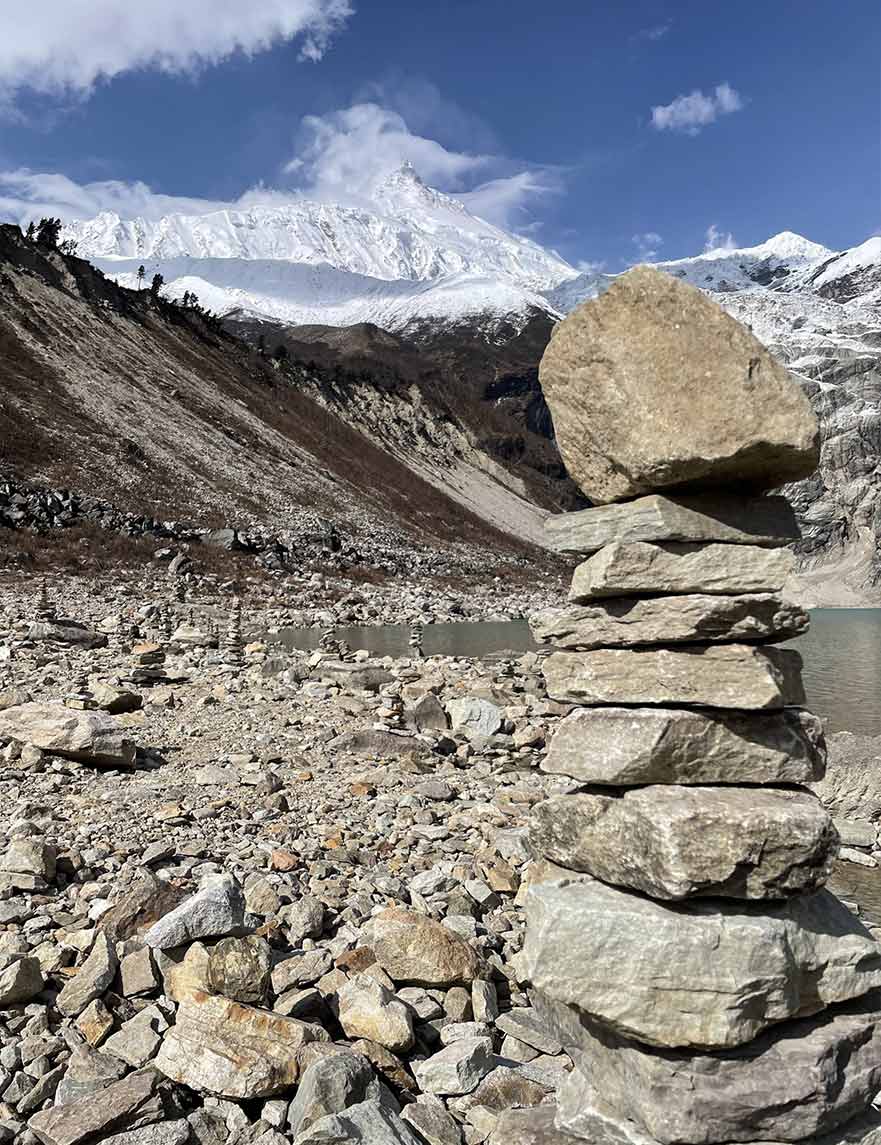
As you trek from Namrung to Lihi (2,910 m), the trail opens up to reveal some of the most beautiful mountain views on the Manaslu Circuit. The major mountain among them is Mount Manaslu (8,163 m). It is also known as “Mountain of the Spirit” and the eighth-highest mountain in the world. Moving forward, you’ll witness Ngadi Chuli (7,871 m)-also known as Peak 29, Baudha Himal (6,672 m), and Shringi Himal.
After walking thorugh pine and bamboo forests for an hour, you’ll reach Samagaun (3,530 m). It is situated in the Budhi Gandaki Valley. If you arrived here earlier, then you can explore this beautiful village. People often add an extra day to their itinerary and stay here for one day. They take a short hike to Birendra Tal and explore Pungyen Gompa. Pungyen Gompa is famous for its traditional masked dance rituals and its old Tibetan-style architecture.
Trek Time:
5–6 hrs/day
Trek Distance:
12 km (7.4 miles)
Sleep Elevation:
3,530 m (11,581 ft)
Accommodations:
Lodge-to-Lodge
Meals:
Breakfast, Lunch, Dinner (B.L.D)
Place:
Samagaun
On this new day, you’ll reach the fresh destination, i.e, Samdo. Since you’re above 3,000 meters, you need to walk slowly. The elevation gain ahead is only about 330 m. To reach Samdo, you’ll pass traditional Sherpa villages, where you can observe local life and stone mani walls. The trail also provides a glimpse of the northern ridges of Manaslu in the distance.
Since it is a short day trek, you’ll reach Samdo (3,860 m) in the afternoon between 2–4 PM. Once you reach there, you can take a rest or go for a short hike to Samdo Peak (5,177 m). It is a prominent peak located in the Manaslu Conservation Area, known for being a lower-altitude, accessible climbing peak suitable for newcomers to acclimate. Not only a short hike, but you can also roam around the village, as it is known for its traditional stone houses and Tibetan Buddhist culture.
Trek Time:
3–4 hrs/day
Trek Distance:
8 km (5 miles)
Sleep Elevation:
3,860 m (12,664 ft)
Accommodations:
Lodge-to-Lodge
Meals:
Breakfast, Lunch, Dinner (B.L.D)
Place:
Samdo
Today is one of the exciting days on the Manaslu trek. You’ll start early from Samdo and follow the ancient salt-trading trail toward Larkye Bazaar (4,460 m), a route that once led to Tibet. In Larkye Bazaar, trekkers often rest, acclimatize, and make plans for the next day’s trek to the high pass. Larkye Bazaar offers basic lodges and teahouses.
After Larkye Bazaar, the trail becomes steeper and more rugged. You pass moraines, glacial streams, and boulder fields, which show the raw beauty of the high Himalayas. The path continues to Dharamsala, also called Larkye Phedi or High Camp (4,460 m). Dharamsala is the final stop before crossing Larkya La Pass. It has very basic stone lodges and a few camping spots managed by the Manalslu Conservation Area Project. The area is quiet, surrounded by snow-covered peaks and glaciers of the Manaslu and Himlung Himal.
Trek Time:
4–5 hrs/day
Trek Distance:
11 km (6.8 miles)
Sleep Elevation:
4,460 m (14,632 ft)
Accommodations:
Lodge-to-Lodge
Meals:
Breakfast, Lunch, Dinner (B.L.D)
Place:
Dharamsala
This is an important day since you’ll hike to the top point of the short Manaslu Circuit trek. Today, you’ll cross Larkya La Pass (5,106 m). The climb passes through rocky terrain, snow patches, and moraines. This is not an easy hike. The trail is steep and challenging, and in bad weather it can be exhausting, but it is still possible to complete. The temperature ranges between -5°C to 5°C, so you should be ready with proper gear.
Once you reach the top, you’ll be amazed by its beautiful scenery. You’ll see glimpses of Himlung (7,126 m), which is close to Tibet, Kang Guru (6,981 m), and Annapurna II (7,937 m) in the Annapurna Range. After crossing the pass, you begin the descent toward Bhimthang (3,720 m). Bhimthang was historically a key salt trading post on the route between Nepal and Tibet, where Tibetan traders exchanged goods with Nepali communities. It is a peaceful stop to rest after a long and strenuous day.
Trek Time:
8–9 hrs/day
Trek Distance:
24 km (14.9 miles)
Sleep Elevation:
3,720 m (12,204 ft)
Accommodations:
Lodge-to-Lodge
Meals:
Breakfast, Lunch, Dinner (B.L.D)
Place:
Bhimthang
Today is your last day in the local teahouses of the Manaslu region. From Bhimthang, you’ll head towards Yak Kharka, a grazing area where locals tend to yaks, and enjoy the south face view of Manaslu. The name “Yak Kharka” translates to “yak pasture” in Nepali, which reflects its traditional use as an alpine meadow for grazing.
After Yak Kharka, you’ll reach Gho village (2,500 m). This village has stone houses, prayer flags, and teahouses that are built in a traditional Tibetan style. From Gho, the trail descends further along the river valley, leading to Tilije (2,300 m). Tilije is situated in the Manaslu Conservation Area, known for its diverse ecology, including oak, pine, and rhododendron forests. It is a comfortable stop after a long day of trekking.
Trek Time:
6–7 hrs/day
Trek Distance:
16 km (10 miles)
Sleep Elevation:
2,300 m (7,546 ft)
Accommodations:
Lodge-to-Lodge
Meals:
Breakfast, Lunch, Dinner (B.L.D)
Place:
Tilije
From Tilije, you’ll start the drive in a local jeep. The trail passes through Dharapani and follows the Marshyanhdi River. Along the way, you’ll see the peaks of Annapurna II and Lamjung Himal (6,983 m). The drive on the rocky road continues until you reach Besisahar (760 m). It is the district headquarters of Lamjung.
From Besishahar, you’ll board a public bus for the journey to Kathmandu. The road again follows the Marshyandgi River until it meets the Trishuli River at Mugling. The route passes through towns like Kuirintar, Galchi, and Dharke before entering the Kathmandu Valley. By evening, you’ll reach Kathmandu Valley (1,400 m), where the Manaslu Circuit trek officially ends.
In the evening, enjoy a warm farewell dinner with our office representatives and your guides at a traditional Nepali restaurant. During this special gathering, we celebrate your journey and give you a chance to share final moments with the team that supported you throughout the trip. The dinner also features cultural performances with dances and songs from various ethnic communities of Nepal. This means you get an authentic and memorable cultural experience before your departure.
Drive Time:
8–9 hrs/day
Drive Distance:
220 km (136.7 miles)
Sleep Elevation:
1,400 m (4,593 ft)
Accommodations:
Not Included
Meals:
Breakfast, Lunch, Farewell Dinner (B.L.D)
Place:
Kathmandu
To respect the varied accommodation preferences of our guests, the Kathmandu stay has been kept optional, so you can freely choose a hotel that best suits your comfort and budget. However, if you would like us to arrange your accommodation, we would be more than happy to assist. Let us know your preference (3-star, 4-star, or 5-star) at the time of booking, and we will include it as an add-on without any hassle.
The Manaslu Circuit Trek is an extraordinary journey. Here are a few reasons why you should go on the trek:
The short trek to Manaslu Circuit is one of the relatively less crowded journey than the other commercialized trek destinations of Nepal. As a result, trekkers can enjoy a serene atmosphere and raw Himalayan wilderness. Its off-beat trekking trails go through diverse and scenic landscapes around Budhi Gandaki Valley. You will trek from lower subtropical regions with dense forests of rhododendrons, oaks, birches, and magnolias to forests of conifers and green pastures. Similarly, you will also trek by rivers, waterfalls, valleys, and gorges. The Manaslu Circuit’s off-beat and scenic trails offer a truly remarkable trekking experience.
The Manaslu Circuit Trek encircles the entire Manaslu massif. Throughout the trek, you will get to enjoy enticing and gorgeous views of the mountain panoramas. You will witness the stunning Mount Manaslu (8,163 m), the world’s eighth-highest mountain. Similarly, you can enjoy crystal-clear views of Mount Himal Chuli (7,893 m), Larkya Peak (6,249 m), Ganesh Himal range, Annapurna range, and others. There are several viewpoints along the route where you can get clear views of the vistas.
The highlight of the Manaslu Circuit Trek is the Larkya La Pass, which sits at an elevation of 5,106 m. It is the highest point of the trek and also the most challenging part. You must trek on rocky and gravel paths as well as glacial moraines to ascend to Larkya La Pass. It is an arduous journey that will test you physically and mentally. However, the climb is also a thrilling experience. The sense of achievement you will get as you reach the top of the pass is worth every second of the challenging ascend. From the top of the pass, you can enjoy stunning views of the mountain panoramas, glacial valleys, and scenic snow-covered landscapes of the Manaslu region.
The trekking trails of the Manaslu Circuit Trek enter both the Manaslu Conservation Area and the Annapurna Conservation Area. Thousands of flora and fauna, including rare and endangered species, inhabit the region. Various species of rhododendrons adorn the forest trails. As you ascend to higher villages like Deng and Namrung, the scenery changes into forests of pines and junipers. The Manaslu region is also home to rare plants like the Himalayan Blue Poppy and Yarsagumba (caterpillar fungus). Lucky trekkers can also catch sightings of rare wildlife such as red panda, Himalayan Tahr, Musk Deer, Himalayan Monal, Blood Pheasant, and more. The trek is an incredible opportunity to witness the unique Himalayan biodiversity of Nepal.
The Short Manaslu Circuit Trek is not only an adventure but also a rich cultural experience. You will experience a unique blend of Nepalese and Tibetan culture around the Nubri and Tsum Valleys. Gurung ethnic groups live in the lower region of the country. As you move to the Upper Manaslu area, you will begin to see a heavy influence of Tibetan culture, as Tibetan-origin groups mainly reside here. You will see traditional settlements and monasteries with Tibetan-style architecture. The locals mostly speak in a Tibetan dialect. Similarly, you will come across several mani walls, prayer wheels, chortens, and colorful prayer wheels. You will also get to experience the warm and friendly hospitality of the locals.
Since the Manaslu region lies in a restricted area, all trekkers must obtain the following permits:
Trekkers will need the Manaslu Restricted Area Permit from Jagat to Sama Gaun. These regions fall within the restricted area, and trekkers must have this permit to access them. The costs for the permit are as follows:
To access the Manaslu region above 1,340 m, you’ll need a Manaslu Conservation Area Permit. This permit covers the section from Jagat to Dharapani that falls inside the Conservation Area. It helps to protect the environment, support local communities, and manage tourism in this remote Himalayan region. The cost for this permit is:
During the Manaslu Circuit Trek, its trekking trails will also access the Annapurna Conservation Area. Trekkers will require this permit from Dharapani until they exit the Annapurna Conservation Area in Besisahar. The ACAP costs are as follows:
SAARC residents: NPR 1000 per person
Non-SAARC residents: NPR 3000 per person
If you plan to extend your trek into the Tsum Valley, then you also need this permit.
You’ll need this permit to enter the Tsum Valley and surrounding villages within the Manaslu region. The local rural municipality office collects this permit, and you need to acquire it in Jagat village during the trek, not through a trekking agency. The costs for the permit are as follows:
Tsum Valley Restricted Area permit, also known as the Tsum-Numbri Local permit, is needed to enter the Tsum Valley and surrounding villages within the Manaslu region. It can be obtained from a trekking agency. Unlike the Tsum Nubri Rural Municipality Permit, which is issued by the local municipality, it is issued by the Department of immigration. The costs for the permit are as follows:
Spring is among the best times to go on the Manaslu Circuit Trek. It has favorable weather and moderate temperatures. The days are bright, warm, and sunny. In early spring, the trails in higher-elevation areas may have some remnants of snow. As the season progresses, the temperature gradually starts to warm, and the snow melts. The warm temperature of spring also makes the flora and fauna active. Hence, the rhododendron-adorned trails bloom in shades of red, pink, and white. Spring also provides an opportunity to spot wildlife. Visibility is also great at this time. So you can witness the gorgeous mountain panoramas without obstruction
| Months | Daytime temperature | Nighttime temperature |
| March | 8 to 10°C | -5 to 5°C |
| April | 10 to 15°C | 0 to 8°C |
| May | 20 to 31°C | 5 to 12°C |
With the most stable weather and temperature, autumn is the next best season for the Manaslu Circuit Trek. The sky is clear, and the air is crisp. It makes for a comfortable and enjoyable trekking experience. The rain from the monsoon continues until mid-September. Hence, the rain cleanses the vegetation and surroundings. The landscape also looks vibrant, lush, and green. Autumn foliage also adds to the beauty of the surroundings. The visibility is also excellent during autumn. You can enjoy spectacular views of the mountain vistas and the landscapes. The biggest Nepalese festivals, Dashain and Tihar, also fall in autumn. So, trekkers can enjoy the festive atmosphere during the Manaslu Circuit Trek.
| Months | Daytime temperature | Nighttime temperature |
| September | 15 to 21°C | Around 7°C |
| October | 10 to 15°C | -2 to 5°C |
| November | 5 to 13°C | -6 to 5°C |
Monsoon begins in Nepal with the summer season. It brings heavy rainfall in lower and hilly areas. The forest trails are also wet, muddy, and slippery. Moreover, leeches infest the trails. Due to heavy rain, there is the risk of landslides and mudslides. The rain cleanses the dust and pollution from the surroundings and landscapes. As a result, the vegetation looks clean and vibrant. Summer is the best time to witness the lush and green scenery. However, trekking in summer requires the right rain gear, proper planning, and preparation.
| Months | Daytime temperature | Nighttime temperature |
| June | 20 to 25°C | 10 to 15°C |
| July | Up to 30°C | 5 to 10°C |
| August | 12 to 25°C | 5 to 15°C |
Winter is off-season for Manaslu Circuit Trek as it begins to snow at higher altitude areas. The temperature also begins to drop as the season progresses. It can drop below freezing point at high elevations. However, the days are usually warm and bright. Winter is the best time to enjoy the snow-covered landscape of the Manaslu region. You can also enjoy gorgeous views of the snow-covered mountain peaks. Trekkers must be careful while trekking in winter. Heavy snow can also block high mountain passes and cover the trails. The accommodations can be closed due to extreme weather. So, trekkers should book one before their trek.
| Months | Daytime temperature | Nighttime temperature |
| December | 8 to 12°C | -8 to -5°C |
| January | -5 to 0°C | -15 to -10°C |
| February | -5 to 5°C | -15 to 10°C |
It is common for trekkers to experience altitude sickness during high-altitude treks like the Short Manaslu Circuit Trek. As you move to an altitude above 2500 meters, the oxygen level and air pressure in the atmosphere begin to decrease. The decreased oxygen in the body causes trekkers to feel discomfort and unwell. The symptoms of altitude sickness include headache, nausea, fatigue, loss of appetite, dizziness, insomnia, and shortness of breath. Its mild symptoms are known as Acute Mountain Sickness. However, it can quickly turn severe, like High-Altitude Cerebral Edema (HACE) or High-Altitude Pulmonary Edema (HAPE).
There are several ways trekkers can prevent or minimize the risk of altitude sickness. These include:
The Manaslu Circuit is a challenging trek that requires reasonable health and fitness. It is a demanding trek that takes 10 to 12 days to complete. During the journey, trekkers must travel from subtropical lowlands to alpine meadows and tundra regions. The terrains are also rough and rugged, and they go through varied terrains. Moreover, trekkers must ascend and descend on steep and narrow trails.
The trek is physically and mentally demanding. On average, trekkers must hike for 4 to 6 hours each day. It requires significant strength, stamina, and endurance to overcome the challenges. The high altitude also adds to the difficulty of the Manaslu Circuit Trek. The lower oxygen level and risk of altitude-related sickness make ascending to higher altitudes physically demanding. Similarly, the weather changes rapidly and becomes unpredictable at higher elevations. It can cause unforeseen events that can add to the trek’s difficulty.

A short trek to Manaslu Circuit requires proper preparation and the right equipment and gear. Trekkers must prepare for the strenuous trails, including crossing the high mountain trail of Larkya La Pass. Adequate acclimatization is also necessary to prevent altitude-related sickness. The isolated location, unpredictable weather, and lack of infrastructure can trigger mental stress in trekkers. Hence, they also build mental resilience for the trek.
You need a Nepali Tourist visa to complete the Short Manaslu Circuit Trek. Most travelers can get this visa on arrival at Tribhuvan International Airport or land borders. The fee is USD 30 for 15 days, USD 50 for 30 days, and USD 125 for 90 days. For a 9–12 day trek, a 30 day visa is the safest choice because it covers time and any unexpected delays.
A licensed guide is mandatory as the region is a government–declared Restricted Area. You cannot enter without a registered Nepali guide, and agencies like HC Treks cannot issue the Restricted Area Permit without one. Guides manage navigation, safety, permits, and local communication. Porters carry 15–20 kg of your luggage and reduce physical strain. Average costs range from USD 30–40 per day for a guide and USD 25–35 per day for a porter.
On the trek, you will need the local money, the Nepalese Rupee (NPR or Rs.) Once you leave the main trailhead, there are no ATMs and no places that accept credit cards or foreign money. So make sure to exchange enough cash into NPR in Kathmandu before you go. As of early December 2025, the rate is about 1 USD = 143 NPR. It’s smart to know this rate so you can plan your budget right.
Travel insurance is mandatory for the Short Manaslu Circuit because it is required to get the Restricted Area Permit. Your policy must cover trekking up to at least 5,500 m, as the highest point, Larkya La Pass, sits at 5,106 m. It should also include emergency helicopter evacuation, which is important in this remote region. Without insurance, evacuations can cost thousands of dollars.
HCTreks offers unforgettable Himalayan adventures with expert guidance and 24/7 support.
Experienced, licensed guides ensuring safety and memorable journeys.
Your safety is our top priority throughout the journey.
Tailor your trek based on preferences, fitness, and time.
We promote sustainable, zero-waste, eco-friendly trekking experiences.
Top-notch service at affordable, transparent, and competitive rates.
Receive daily weather forecasts and route updates for safety.