Nepal has returned to normal after the recent protests. Book your trek with confidence.
The Gokyo Ri Trek is a marvelous journey to the hidden gem of the Everest region, the Gokyo Valley. It is also a great alternative to the classic trails of the Everest Base Camp Trek (EBC). The trekking trails are off-beat and less crowded than EBC, allowing you to enjoy the raw Himalayan wilderness and tranquil atmosphere.
Gokyo Ri Trek is among the lesser-known and underrated trekking routes of the Everest region. As a result, the trekking trails are quieter and less busy. It is a great opportunity for trekkers looking to escape from their hectic lifestyle into the lap of nature. The trek begins in Lukla and traverses iconic villages like Phakding, Namche Bazaar, Dole, Machhermo, Gokyo, and more. Hence, it allows you to peek at the local culture, traditions, and lifestyle. You will trek from lower subtropical forests of rhododendrons, oaks, firs, and birches to conifer forests and highland meadows. Similarly, you will trek past icy rivers, snowfields, and glacier moraines during the Gokyo Lake Trek.
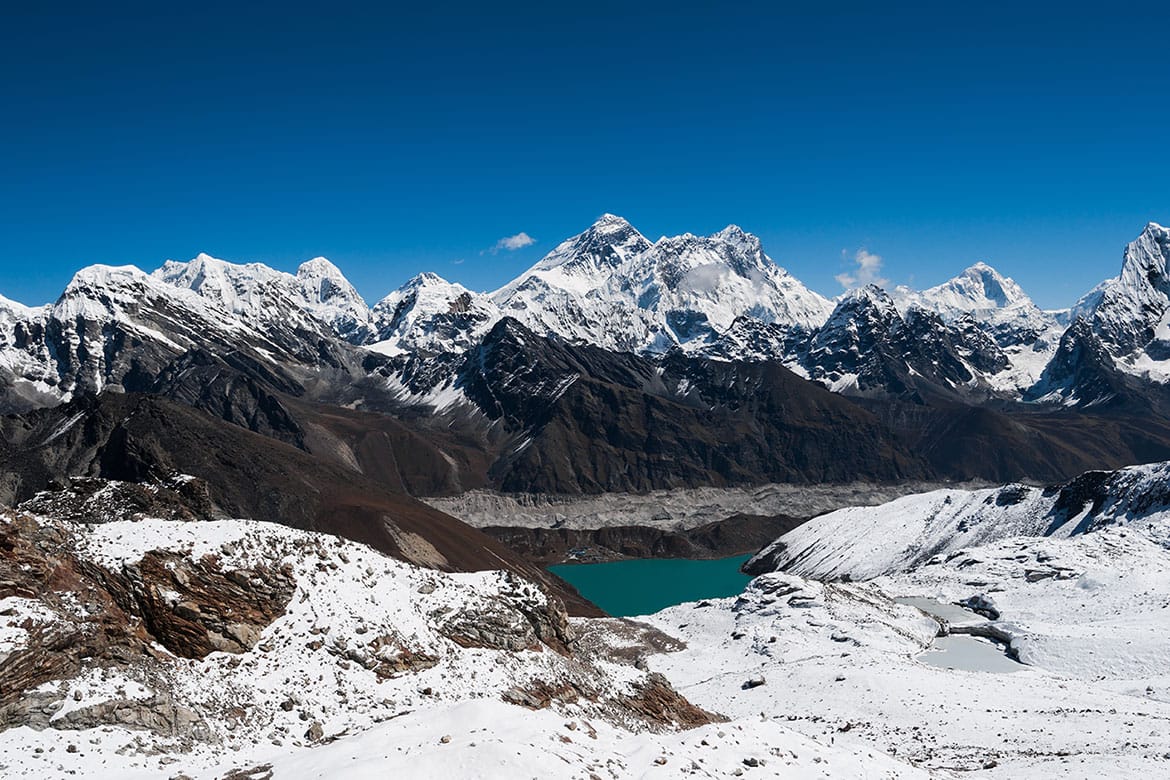
The highest point of the trek is Gokyo Ri (5,357 m), a high-altitude vantage point. From here, you can witness magnificent views of towering snow-capped peaks like Mount Everest, Lhotse, Ama Dablam, Makalu, and many more. In fact, many trekkers consider the view of Mount Everest from Gokyo Ri to be more spectacular than Kala Patthar (5,545 m). You will also witness marvelous views of Nepal’s largest glacier, Ngozumpa Glacier, and the turquoise-colored Gokyo Lakes. The Gokyo Lakes stretch from an altitude of 4,700 m to 5,000 m. They are one of the world’s largest freshwater lake systems. The trek route traverses these lakes, offering unmatched views and extraordinary adventure. Get a thrilling trek experience along with rich cultural immersion and surreal views with the Gokyo Ri Trek!
Your journey begins with a short and scenic flight from Kathmandu to Lukla. We will see the Gaurishankar mountain, Langtang mountain range, Dorje Lhakpa range, Everest range, and even the Shishapangma range of China. The best views are from the left side of the airplane. If the flight goes via Manthali Airport, the experience is the same, and you still get clear Himalayan views.
We usually don’t start the trek immediately after landing. After landing, we will meet our trekking team at the airport gate. If the flight is early, we will have breakfast in Lukla. If the flight is later, we will go for lunch first. We will hold a short meeting with everyone involved in the trek to discuss the plan for the day and prepare for the walk ahead. This also gives time to adjust, check gear, and enjoy the first mountain atmosphere of the Everest region.
While trekking from Lukla to Phakding, we’ll complete the national park entry and local entry. The people in this area are mostly Buddhist, and we will experience the local way of Buddhist life. You’ll start to see prayer flags, stone carvings, monasteries, and Chorten (Stupa) monuments along the trail.
Note: During peak season, flights from Kathmandu often shift to Manthali due to air traffic, so you’ll take a short 20–minute flight to Lukla from there.
Flight Time:
40 min (Kathmandu-Lukla), 20 min (Manthali-Lukla)
Trek Time:
3 hrs/day
Trek Distance:
7.5 km (4.6 miles)
Sleep Elevation:
2,610 m (8,563 ft)
Accommodations:
Lodge-to-Lodge
Meals:
Breakfast, Lunch, Dinner (B.L.D)
Place:
Phakding
We’ll wake up around 7:00 AM and have breakfast (already ordered on the previous day) at 7:30 AM. We’ll start our trek at 8–8:30 AM. The trail follows the Dudh Koshi River, and we cross the river many times on long suspension bridges. There are waterfalls on the way, and you will also see small farmland growing vegetables for trekkers.
Before the final climb, we pass the entry point of Sagarmatha National Park at Monjo (2,835 m), where your permits are checked. Beyond this point, there is no vegetable farmland, and the landscape becomes more forested and rocky. We continue through pine woods, small settlements, and viewpoints until we reach the long approach to the high bridges.
After crossing the final high suspension bridge, including the famous Hillary Bridge (the highest one), the character of the trek changes fully. We begin a steep ascent known as “Namche Hill,” which can take a couple of hours. If the weather is clear, we may get our first view of Mount Everest along this climb. Slowly, Namche Bazaar (3,440 m) comes into sight. It is the main Sherpa town in the region and the gateway to higher Himalayan valleys.
Trek Time:
5–6 hrs/day
Trek Distance:
7.4 km (4.5 miles)
Sleep Elevation:
3,440 m (11,286 ft)
Accommodations:
Lodge-to-Lodge
Meals:
Breakfast, Lunch, Dinner (B.L.D)
Place:
Namche Bazaar
Today is our acclimatization day at Namche Bazaar. We will wake up at 6:00 AM to enjoy the best morning views of the mountains and have breakfast by 6:30 AM. You’ll start walking around 7–7:30 AM for a 1.5 hour hike to the Everest Viewpoint. From this spot, we can see Everest (8,848.86 m), Lhotse (8,516 m), Nuptse (7,861 m), Ama Dablam (6,812 m), Kangtega–The Snow Saddle (6,782 m), Thamserku (6,608m), and Kusum Kanguru (6,367 m), and many other peaks. In this region, summiting certain mountains is not allowed. One of these sacred peaks is Khumbu Yul Lha, which is worshipped by the local Sherpa community.
After enjoying the viewpoint, we continue toward Khumjung village (3,790 m), known for the monastery that stores the famous Yeti skull. From there, we walk to Khunde village, where we visit the largest hospital in the region. We also stop at the Syangboche Yak Farm and Breeding Center and then reach Syangboche Airport, which stands at around 3,780 m. This airport is one of the highest-located airstrips in the world.
On our way back to Namche, we visit the Sagarmatha National Park Museum, where we learn about Sherpa history and see records of Everest climbers. We will also visit the largest monastery in Namche. If it is Friday or Saturday, we can explore the weekly local market where farmers from nearby villages come to trade goods.
Trek Time:
3–4 hrs/day (optional)
Trek Distance:
8 km (4.9 miles)
Sleep Elevation:
3,440 m (11,286 ft)
Accommodations:
Lodge-to-Lodge
Meals:
Breakfast, Lunch, Dinner (B.L.D)
Place:
Namche Bazaar
The Namche Bazaar to Dole trail begins to get challenging. We must make several uphill and downhill climbs through thick subtropical and pine forests. The trail first begins to descend to Mong La Pass (3,957 m) and reaches Phortse Thenga (3,840 m). From here onwards, we will trek through alpine meadows and ascend gradually. The view of Mount Ama Dablam and Khumbila accompanies us through our climb. Finally, after trekking for around five hours, we will reach Dole (4,038 m). It is our stop for the night.
Trek Time:
5 hrs/day
Trek Distance:
12 km (7.5 miles)
Sleep Elevation:
4,038 m (13,248 ft)
Accommodations:
Lodge-to-Lodge
Meals:
Breakfast, Lunch, Dinner (B.L.D)
Place:
Dole
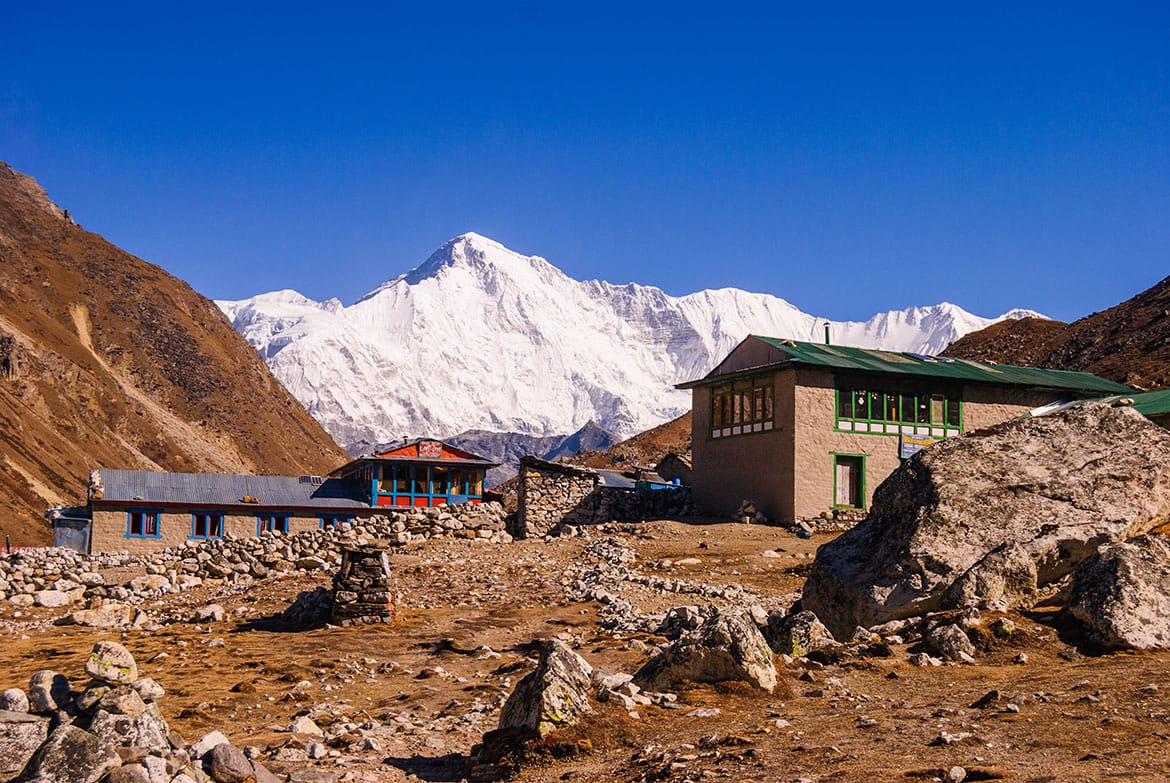
We will enjoy a hearty breakfast while enjoying the views at Dole. Then, we will continue our trek on rugged trails. En route from Dole to Machhermo, we will pass several small shrines, chortens, and colorful flags until Lapahrma. The small village of Lapahrma offers a gorgeous view of the world’s fifth-highest mountain, Mount Cho Oyu, as well as Mount Kantega (6,782 m) and Thamserku (6,608 m). We will leave Lapahma, passing by green highland pastures. After trekking for a while, we will enter the Luja Valley and reach Machhermo (4,470 m). We will rest our tired feet here for the night.
Trek Time:
5–6 hrs/day
Trek Distance:
7 km (4.3 miles)
Sleep Elevation:
4,470 m (14,665 ft)
Accommodations:
Lodge-to-Lodge
Meals:
Breakfast, Lunch, Dinner (B.L.D)
Place:
Machhermo
With an exciting day ahead of us, we will leave Machhermo and continue our journey to Gokyo after breakfast. The trail will first take us to Phanga (4,323 m) village, where we can see an area dedicated to those who lost their lives in landslides. After passing Phanga, we will cross an iron bridge and reach one of the first lakes of the Gokyo Lake system, Longpongo (4,690 m). The beautiful lake is a small glimpse of what is to come. We will continue moving forward and trek through the Ngozumpa Glacier moraine. A little further, we will get a stunning view of Gokyo Lakes in a sequence that will leave us in awe of their beautiful waters and surrounding beauty. We will continue trekking while marveling at the view until we reach the Gokyo village (4,750 m).
Trek Time:
4 hrs/day
Trek Distance:
5.7 km (3.5 miles)
Sleep Elevation:
4,750 m (15,584 ft)
Accommodations:
Lodge-to-Lodge
Meals:
Breakfast, Lunch, Dinner (B.L.D)
Place:
Gokyo Village
We will wake up at the serene Gokyo village, surrounded by stunning glacial lakes. After enjoying breakfast, we will prepare for our hike from Gokyo village to Gokyo Ri. It is an exciting as well as challenging climb. The trail to this famous vantage point requires us to trek uphill on rough and rocky trails. However, the climb will be worth it. The view from Gokyo Ri (5,357 m) is breathtakingly beautiful. You can witness the marvelous view of Everest and the other surrounding Himalayas. Similarly, you can witness the turquoise lakes and icy glaciers from here. After seeing the marvelous view and exploring around, we will return to the Gokyo Village.
Trek Time:
2–4 hrs/day
Trek Distance:
2 km (1.2 miles)
Sleep Elevation:
4,750 m (15,584 ft)
Accommodations:
Lodge-to-Lodge
Meals:
Breakfast, Lunch, Dinner (B.L.D)
Place:
Gokyo Village
It is time for us to say goodbye to the hidden Gokyo village and the icy Gokyo Lakes. We will have breakfast while enjoying the view and tranquil atmosphere before returning. On this day, we will retrace our steps, passing by pine forests and rhododendron groves. Similarly, we will pass by familiar villages, stupas, and chortens to reach Phortse (3,840 m). We will stay overnight at a lodge in the village.
Trek Time:
6 hrs/day
Trek Distance:
15.5 km (9.6 miles)
Sleep Elevation:
3,840 m (12,598 ft)
Accommodations:
Lodge-to-Lodge
Meals:
Breakfast, Lunch, Dinner (B.L.D)
Place:
Phortse
From Phortse, we will continue descending through dense subtropical forests and witnessing the diverse Himalayan flora and fauna. It is mostly a downhill trek with a few uphill climbs. We will cross several wooden suspension bridges, colorful prayer flags, mani walls, and chortens to reach Namche Bazaar (3,440 m). We will stay overnight at a lodge in Namche so you can stroll around the town, shops, and restaurants.
Trek Time:
6 hrs/day
Trek Distance:
9.1 km (5.6 miles)
Sleep Elevation:
3,440 m (11,286 ft)
Accommodations:
Lodge-to-Lodge
Meals:
Breakfast, Lunch, Dinner (B.L.D)
Place:
Namche Bazaar
Today is our final trekking day. After our breakfast at Namche Bazaar, we will continue descending downhill. We will exit the Sagarmatha National Park and pass through notable villages like Monjo, Jorsale (2,740 m), Phakding, Benkar (3,230 m), and more. Similarly, we will pass by picturesque terrace fields, suspension bridges, stupas, etc. The trail from Phadking begins to get gentler, and the mountain view starts to become distant. We will reach Lukla (2,860 m) after a whole day’s trek and stay there overnight.
Trek Time:
8–9 hrs/day
Trek Distance:
14.9 km (9.2 miles)
Sleep Elevation:
2,860 m (9,383 ft)
Accommodations:
Lodge-to-Lodge
Meals:
Breakfast, Lunch, Dinner (B.L.D)
Place:
Lukla
Today is the last day of our trek. We will take an early flight back to the capital city after breakfast at Lukla. The flight offers one last glimpse at the beautiful landscapes of the Khumbu region and mountain views. Our representative will drop you off at the hotel you booked in Kathmandu, and our package will come to an end. Plus, if you want to participate in the sightseeing tour in Kathmandu, we can arrange it separately.
In the evening, enjoy a warm farewell dinner with our office representatives and your guides at a traditional Nepali restaurant. During this special gathering, we celebrate your journey and give you a chance to share final moments with the team that supported you throughout the trip. The dinner also features cultural performances with dances and songs from various ethnic communities of Nepal. This means you get an authentic and memorable cultural experience before your departure. Thank you for choosing us, and we hope you had a wonderful time with us!
Flight Time:
40 min
Sleep Elevation:
1,400 m (4,593 ft)
Accommodations:
Not Included
Meals:
Breakfast, Lunch, Farewell Dinner (B.L.D)
Place:
Kathmandu
To respect the varied accommodation preferences of our guests, the Kathmandu stay has been kept optional, so you can freely choose a hotel that best suits your comfort and budget. However, if you would like us to arrange your accommodation, we would be more than happy to assist. Let us know your preference (3-star, 4-star, or 5-star) at the time of booking, and we will include it as an add-on without any hassle.
To start the Gokyo Ri Trek, you must fly from Kathmandu (1,400 m) to Lukla (2,860 m). The flight to Lukla takes around 40 minutes. The picturesque town of Lukla serves as the gateway to the Everest region. After a 40-minute flight, you will begin your trek journey. Since it is the first day of your trip, you will trek for around three hours to get to Phakding (2,610 m). The trails are also relatively easy and go alongside the Dudh Koshi River and forests of conifers.
You will start trekking alongside the Dudh Koshi River from Phakding. Along the way, you will cross several wooden suspension bridges and pass by colorful prayer flags. Then, you will reach the Monjo Village. A few distance from Monjo lies the Sagarmatha National Park entrance. From here onwards, you will enter a dense subtropical forest. The trail gets steeper as you get closer to Namche Bazaar (3,440 m). You will also get your first glimpse at Mount Everest. You will reach Namche Bazaar and take an acclimatization day here.

During the acclimatization day, you can take a short excursion to Khumjung (3,790 m), Syangboche Airport (3,780 m), or Everest View Hotel. From Namche Bazaar, you will start ascending to Mong La Pass (3,957 m) and head towards Phortse Thenga. The trail begins to enter the forests of conifers, and you can get a clear view of Mount Ama Dablam and Khumbila. After trekking for a while, you will reach Dole (4,038 m). The trail from Dole passes through several shrines and is adorned with colorful prayer flags. It takes you to Lapahrma Village and past beautiful yak grazing pastures. You will then enter the Luja Valley to reach Macchermo (4,470 m).
The trail gradually begins to ascend towards Gokyo Village (4,750 m). En route, we will come across Phanga and cross an iron bridge to Longpongo (4,690 m). Similarly, you will trek through the Ngozumpa Glacier to reach the serene and beautiful Gokyo Village. The famous vantage point of Gokyo Ri (5,357 m) is a short hike from the village. From the Gokyo Ri, you can witness breathtaking views of the surrounding Himalayas, glaciers, and turquoise lakes.
You will descend from Gokyo Village, retracing your steps back to Phortse. You will trek through dense rhododendron forests and mostly descend downhill. From Phortse, you will continue returning to the familiar trails and reach Namche Bazaar. The trek is mostly downhill through picturesque villages, terrace farms, dense forests, and suspension bridges. The trail begins to get gentler from Phakding and heads towards Lukla. Early the next morning, you will take a flight back to Kathmandu.
Spring is one of the best times to trek Gokyo Lake. It has one of the most favorable weather and climatic conditions with moderate temperatures. During early spring, the temperature is a little chilly, and there are remnants of snow on the trails of higher regions. As the season progresses, the snow melts, and the days become warmer. The flora and fauna also start to become more active. As a result, the rhododendron-adorned trails also fully bloom, coloring the entire landscape. The average temperature during the day ranges between 5°C to 15°C. Meanwhile, the nighttime temperature can drop below -5°C. Spring is the best time to enjoy the vibrant and colorful landscapes of the Everest region. There is also low rainfall, so trekkers can enjoy clear views of the mountain panoramas.
The peak trekking season for Gokyo Lake Trek is autumn. It has one of the most stable weather and mild temperatures for a comfortable trekking experience. The monsoon can cause rainfall in lower and hilly regions in early autumn. But the monsoon soon leaves the country, leaving the vegetation and landscapes lush, green, and fresh. During autumn, the sky is crisp and clear. Hence, the visibility is also crystal-clear as the rain washes the impurities from the atmosphere. The average daytime temperature ranges between 2°C to 18°C. At nighttime, the temperature can drop below freezing point at higher elevations. Autumn is the best time to enjoy the clear mountain views and colorful autumn foliage of the Everest region.
There are charming teahouses, lodges, and guesthouses offering food and accommodation facilities along the Gokyo Ri Trek route. Due to the remoteness of the location, there is a lack of facilities and infrastructure. Therefore, these stays are simple and basic, with limited amenities. Locals operate these accommodations. Generally, the rooms are on a shared basis with limited furniture. Some stays are dormitory-style. They offer beds, mattresses, blankets, and pillows. Meanwhile, the bathrooms are usually communal.
Most of these rooms have poor insulation and no heating facilities. Hence, it is best that trekkers carry a sleeping bag to keep themselves warm at night. Almost all accommodations have massive stone stoves for heating in their communal dining space. Lodges at Namche Bazaar have better facilities, such as rooms with heating facilities, attached bathrooms, etc. However, they are pretty expensive.
During the 11 Days Gokyo Ri Trek, you will get to taste authentic Nepalese cuisine. The teahouses and eateries along the trek route offer various meal options that include Nepalese as well as international cuisines. Some of the popular food items available include oatmeal, cornflakes, french toasts, Tibetan bread, eggs, Tsampa porridge, pancakes, muesli, Dal Bhat, curries, chapati, Tenduk, noodles, momo (dumpling), Sherpa stew, sandwiches, pasta, spaghetti, salad, soup, french fries, dessert (apple pie, rice pudding, etc.), bakeries, and more. The drink options include tea (black/ milk/ green), hot lemon with ginger and lemon, juices, soft drinks, and alcoholic beverages.
The trek package only covers bed, breakfast, lunch, and dinner. Additional services like hot water/ shower, charging electronic devices, soft drinks, alcoholic beverages, etc., will cost trekkers additional charges.
It is common for trekkers to experience altitude sickness or Acute Mountain Sickness (AMS) during high-altitude treks like the Gokyo Ri. After crossing the elevation of 2,500 m above sea level, the oxygen level and air pressure in the atmosphere begin to decrease. The symptoms of altitude sickness occur when the body is unable to adapt to the growing altitude. During the Gokyo Ri Trek, trekkers will reach an altitude of 5,357 m. Therefore, there is a risk of altitude sickness during the trek.
The higher you go, your body seeks more oxygen due to increased metabolism. The reduced oxygen level in the body can lead you to experience various symptoms. They can range from mild to severe and, in some cases, can be fatal. Common symptoms include headache, nausea, dizziness, insomnia, loss of appetite, shortness of breath, rapid heart rate, etc. Trekkers must watch out for these symptoms during the Gokyo Ri Trek.
Some of the ways trekkers can prevent altitude sickness during Gokyo Ri Trek are:
The Gokyo Ri Trek is a moderate-grade venture that requires good physical and mental preparation. It is relatively less challenging than the EBC Trek. Anyone in good health and fitness can participate. However, the trek has its challenges. During the trek, you must ascend and descend on varied terrains. The trails do not have technical sections, but there are several steep and narrow sections. Similarly, trekkers must also conquer steep stone staircases to get up to the Gokyo Ri. The average trekking hours per day is 4 to 6 hours.
Long hours of trekking on rough and rugged terrains are physically as well as mentally demanding. Climbing to the high altitude adds to further challenges. As you climb to higher altitude regions, the lower oxygen level and increased metabolism can cause over-exertion. It also exposes trekkers to the risk of altitude sickness. Similarly, the weather also becomes unpredictable in higher areas. It can cause unforeseen challenges during the trek.
Aside from physical difficulty, trekkers will also face mental challenges during the Gokyo Ri Trek. The route lies in a remote and rural area with no proper infrastructure or facilities. Similarly, off-the-beaten trails offer a serene trekking experience but can also make trekkers feel isolated. The lack of facilities, demanding hikes, unforeseen challenges, and secluded trails can cause mental stress to trekkers. Hence, trekkers must be prepared for the various physical and mental challenges during the Gokyo Ri Trek.
Tipping on the Gokyo Ri trek is not mandatory, but it is an important and expected way to thank your guide and porter for their hard work. Most trekkers tip in Nepalese rupees, as it is easier for staff to use them in the mountains. A guide and porter usually receives USD 5–10 per day. Tips are normally given at the end of the trek, often inside an envelope and handed over quietly as a sign of respect.
The trail reaches over 5,000 m, so follow your acclimatization days in Namche and Gokyo and walk slowly. Drink plenty of water, avoid alcohol, and watch for symptoms like headache or nausea. If you feel unwell, tell your guide and descend. Good planning and simple daily habits keep you safe at high altitude.
Travel insurance is essential for the Gokyo Ri trek because the route goes above 5,000 m and sits in a remote area with limited medical care. Choose a policy that covers up to at least 6,000 m and includes emergency helicopter rescue, as this is the fastest way to get help during serious altitude issues. Make sure the plan covers full medical costs, buy it before leaving your home country, and keep copies of your policy with you on the trail.
You will need Nepalese Rupees (NPR) for the entire trek because the trail runs on a full cash system. No ATMs or card payments are available beyond Lukla and Namche Bazaar, so exchange enough money in Kathmandu before flying out at the rate of 1 USD = 143 NPR. Prices rise with altitude, and daily costs often range from USD 25–35 for meals and lodging.
While packing for the Gokyo Ri Trek, you must ensure you are carrying only the necessary items. By doing this, you will be able to enjoy the trip without worrying about tiring your shoulders with heavy bags. Here is a simple packing guide to help you sort things out.
HCTreks offers unforgettable Himalayan adventures with expert guidance and 24/7 support.
Experienced, licensed guides ensuring safety and memorable journeys.
Your safety is our top priority throughout the journey.
Tailor your trek based on preferences, fitness, and time.
We promote sustainable, zero-waste, eco-friendly trekking experiences.
Top-notch service at affordable, transparent, and competitive rates.
Receive daily weather forecasts and route updates for safety.