
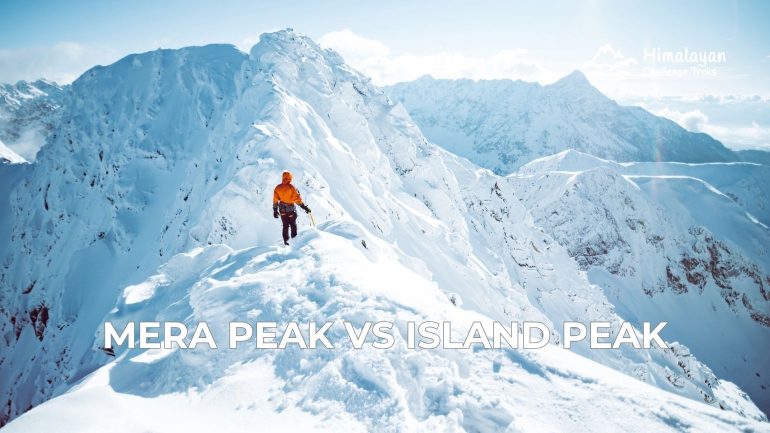
Mera Peak and Island Peak are Nepal’s two most climbed trekking peaks. Both sit in the Everest region, both are achievable without prior mountaineering experience, and both put you above 6,000 meters with world-class Himalayan views. But they test you in different ways. Mera Peak is a long, high-altitude walk with almost no technical climbing. Island Peak is shorter but throws a genuinely technical ice headwall at you near the summit. Picking between them comes down to what kind of challenge you’re looking for, not which one is “better.”
If you’re considering Island Peak Climbing with EBC, you’ll combine the iconic Everest Base Camp trek with a challenging alpine ascent, creating a more complete Everest experience that blends trekking, mountaineering, and some of the Himalayas’ most spectacular scenery.
This guide breaks down the real differences, route, difficulty, permits, cost, and which one actually suits your experience level, so you can decide with your eyes open.
Quick Comparison: Mera Peak vs Island Peak
| Feature | Mera Peak | Island Peak |
|---|---|---|
| Elevation | 6,476 m / 21,247 ft | 6,165 m / 20,305 ft |
| Alpine Grade | PD- (Peu Difficile / Slightly Difficult) | PD+ (Peu Difficile Plus / A Bit Difficult) |
| Location | Hinku Valley, Barun Region | Imja Valley, Khumbu region |
| Typical Duration | 15-18 days | 15-16 days (often combined with EBC) |
| Technical Climbing | Minimal, glacier walking, short roped sections | Moderate, fixed-rope headwall, crevasse crossings |
| Crowd Level | Quiet, remote trail | Busy, shares the classic EBC trail |
| Standout View | 5 x 8,000m peaks from the summit | Close-up of Lhotse, Nuptse, and Ama Dablam |
| Best For | Altitude and solitude over technical difficulty | Technical challenge without minding EBC crowds |
| Permit Cost (Spring) | USD 350 / climber | USD 350 / climber |
What Is the Main Difference Between Mera Peak and Island Peak?
The biggest difference is what makes each climb difficult. Mera Peak is the highest trekking peak in Nepal. It tests your endurance at extreme altitude, while Island Peak tests your technical climbing skills. Simply put, Mera Peak is a fit hiker’s mountain, whereas Island Peak adds a genuinely technical climbing section to the mix.
Mera Peak Focuses on High-Altitude Endurance
It is a climb built around altitude rather than technical difficulty. The standard Mera Peak climbing route follows the remote Hinku Valley, gaining elevation gradually before reaching Mera Base Camp and High Camp. Although Mera Peak is slightly higher than Island Peak at 6,476 meters, the terrain remains fairly gentle, with long glacier sections and snow slopes of around 25-35 degrees. Crampons and an ice axe are necessary, but they’re mainly used for secure footing instead of steep climbing.
The challenge is the amount of time spent high on the mountain. Summit day usually lasts 8-12 hours, and several nights are spent above 4,000 meters, where the thinner air slows every step. Mera Peak has three distinct summits: Mera North (6,476 m), Mera Central (6,461 m), and Mera South (6,065 m). While Mera North is the highest point, Mera Central is the standard and most frequently climbed summit for commercial expeditions. For most people, fitness, endurance, and good acclimatization matter much more than climbing experience.
Island Peak Focuses on Technical Mountaineering
Most of the approach is straightforward, but the summit section is much more demanding than anything on Mera Peak. Climbers ascend a 45-50-degree ice and snow headwall using fixed ropes, jumars, crampons, and an ice axe before continuing along a narrow summit ridge. The route also crosses a crevassed glacier, and ladder crossings may be required depending on seasonal conditions.
The overall expedition is shorter than Mera Peak, but the summit requires solid rope work and confidence on steep terrain. For that reason, most operators include a training session at Chhukhung or Island Peak Base Camp, where climbers practice using jumars, fixed ropes, and other climbing equipment before the summit attempt. This is why Island Peak is often recommended for trekkers who want to learn basic mountaineering skills while climbing a 6,000-meter Himalayan peak.
How Technical Is Mera Peak Compared to Island Peak?
Mera Peak is much less technical than Island Peak. It requires only basic mountaineering skills, like walking with crampons, using an ice axe for balance, and ascending a short fixed-rope section near the summit with a jumar. Because this section is brief and less exposed, the climb is primarily a test of endurance rather than technical ability.
Island Peak requires more advanced technical skills. The summit push involves climbing a steep 45-50-degree ice-and-snow headwall on fixed ropes. You cross crevasses that may require ladders and traverse a narrow, exposed summit ridge. Climbers must confidently use crampons, an ice axe, and jumars throughout the technical section. Additionally, cold weather management during summit day on Island Peak is critical. Because the ice headwall relies on a single line of fixed ropes, traffic jams at anchor points can force long waits in freezing sub-zero temperatures (-15°C to -20°C), making proper boots, warm layers, and patience essential.
Both peaks are suitable for beginners with a licensed guide and pre-climb training, but Island Peak demands much greater technical competence, while Mera Peak relies more on endurance, acclimatization, and fitness.

Mera Peak vs Island Peak Route
Both expeditions begin with a scenic flight to Lukla, but their routes diverge immediately. Mera Peak heads into the remote Hinku Valley and offers a quieter wilderness experience, while Island Peak follows the popular Everest Base Camp (EBC) trail before branching into the Imja Valley. Both itineraries include acclimatization days, climbing training, and a weather contingency day, but they differ in duration, scenery, and technical difficulty.
Mera Peak Route
The standard Mera Peak itinerary takes 16 days, following a gradual ascent through the Hinku Valley before the summit attempt.
Operational Note: This 16-day itinerary uses the lower-altitude circuit via Panggom and Ningsow for the approach. This allows safer, gradual acclimatization before joining the Hinku Valley. Once acclimated after the summit, the return takes the direct, high-pass route crossing Zatrwa La (4,600 m) back to Lukla.
| Day | Route | Highlights |
|---|---|---|
| 1 | Lukla to Paiya | Scenic flight and trek through lush forests away from EBC crowds. |
| 2 | Paiya to Panggom | Cross Panggom La Pass with the first views of Mera Peak. |
| 3 | Panggom to Ningsow | Trek through bamboo and rhododendron forests on quiet trails. |
| 4 | Ningsow to Chhatra Khola | Enter the Makalu Barun National Park region. |
| 5 | Chhatra Khola to Kothe | Join the Hinku Valley trail beside the Hinku River. |
| 6 | Kothe to Thangnak | Pass Lungsumgba Monastery with excellent mountain views. |
| 7 | Acclimatization at Thangnak | Hike to Sabai Tsho to aid acclimatization. |
| 8 | Thangnak to Khare | Climb past glacial moraines to the main climbing base. |
| 9 | Training at Khare | Practice crampon use and complete a gear check. |
| 10 | Khare to High Camp | Reach High Camp and prepare for the summit. |
| 11 | Summit Mera Peak (6,476 m) to Khare | 8-12-hour summit day across the glacier. |
| 12 | Contingency Day | Weather reserve day if needed. |
| 13 | Khare to Kothe | Descend through the Hinku Valley. |
| 14 | Kothe to Thuli Kharka | Climb toward Zatrwa La Pass. |
| 15 | Thuli Kharka to Lukla | Cross Zatrwa La Pass and return to Lukla. |
| 16 | Fly to Kathmandu/Ramechhap | End of the expedition. |
Island Peak Route
The standard standalone Island Peak itinerary takes 14 days, using the Everest Base Camp trail for acclimatization before entering the Imja Valley.
Note: The 15-day itinerary below represents a standalone, direct route to Island Peak via Chhukhung. If you wish to include Everest Base Camp and Kala Patthar, the expedition requires a 16-to-18-day itinerary.
| Day | Route | Highlights |
|---|---|---|
| 1 | Lukla to Phakding | Easy trek along the Dudh Koshi River. |
| 2 | Phakding to Namche Bazaar | Enter Sagarmatha National Park and cross suspension bridges. |
| 3 | Acclimatization at Namche | Hike to Everest View Hotel for panoramic Himalayan views. |
| 4 | Namche to Pangboche | Pass Tengboche Monastery into the upper Khumbu. |
| 5 | Pangboche to Dingboche | Gradual ascent into the Imja Valley. |
| 6 | Acclimatization at Nangkarshang Peak | Gain altitude above 5,000 m for better acclimatization. |
| 7 | Dingboche to Chhukhung | Short 2–3 hour morning trek, gear check, and afternoon rest (optional hike to Chhukhung Ri). |
| 8 | Chhukhung to Island Peak Base Camp | Reach Base Camp along the Imja Glacier. |
| 9 | Training at Base Camp | Practice fixed-rope climbing, jumar use, and rappelling. |
| 10 | Summit Island Peak (6,165 m) and return to Chhukhung | 10–14-hour summit day with glacier travel, a steep headwall, and a narrow summit ridge. |
| 11 | Contingency Day | Weather reserve day if needed. |
| 12 | Chhukhung to Pangboche (or Tengboche) | Descend through Dingboche and the Imja Valley, enjoying easier trekking and lower altitude. |
| 13 | Pangboche/Tengboche to Namche Bazaar | Cross forests and suspension bridges back to the Sherpa capital. |
| 14 | Namche Bazaar to Lukla | Final trekking day. |
| 15 | Fly to Kathmandu/Ramechhap | End of the expedition. |
Aviation Note: During peak trekking seasons (Spring and Autumn), commercial Lukla flights operate out of Manthali Airport in Ramechhap instead of Kathmandu. Trekkers flying into Ramechhap will transfer to Kathmandu via a 5-6 hour private drive arranged by HCTreks.
Which Peak Offers Better Mountain Views?
Both peaks offer spectacular Himalayan panoramas, but the experience is very different. Mera Peak offers a broader, more expansive view. From its summit, you can see five 8,000-meter peaks in a single panorama: Everest, Lhotse, Cho Oyu, Makalu, and Kanchenjunga. Its unique location on the southern edge makes it one of the few viewpoints in Nepal where Kanchenjunga, the world’s third-highest mountain, is visible on the distant eastern horizon.
Island Peak, on the other hand, offers a closer and more dramatic perspective. The summit is dominated by the towering south faces of Lhotse and Nuptse, while Ama Dablam appears remarkably close. However, the massive wall of Lhotse blocks much of the wider Himalayan panorama, so you won’t enjoy the same sweeping multi-peak views as on Mera Peak.
Mera Peak vs Island Peak: Which Is More Difficult?
Although both are challenging 6,000-meter peaks, they’re difficult for different reasons. Island Peak is technically more difficult. It carries a PD+ (Peu Difficile Plus) alpine grade, compared to Mera Peak’s PD- (Peu Difficile / Slightly Difficult) rating. The climb includes a steep headwall where you’ll use fixed ropes, jumars, crampons, and an ice axe, so basic mountaineering skills are essential.
Mera Peak is physically more demanding. At 6,476 meters, it’s nearly 300 meters higher than Island Peak (6,165 meters) and involves a longer approach through the remote Hinku Valley. The summit day is longer, colder, and more of an endurance challenge, with fewer comforts along the route.
Mentally, the two peaks test different strengths. Mera Peak rewards patience and stamina over long days at altitude, while Island Peak requires confidence on steep, exposed terrain during a short but intense summit push. If you’re strong on endurance but don’t enjoy exposure, Mera Peak will probably feel more manageable. If you’re comfortable with ropes and heights and prefer a shorter expedition, Island Peak may suit you better.
While exact figures vary between operators, Mera Peak generally has a higher summit success rate than Island Peak because it is less technical. Island Peak typically sees a lower success rate due to the additional climbing skills required.
Who Should Choose Mera Peak?
Mera Peak is a great choice if your goal is to experience a 6,000-meter Himalayan summit without advanced technical climbing. It’s especially suited for:
- First-time high-altitude climbers who want to reach 6,000 meters without tackling steep ice or complex rope work.
- Solitude seekers looking for a quieter, more remote trekking experience away from the busy Everest Base Camp trail.
- Future mountaineers who want to gain high-altitude experience before attempting more technical peaks like Ama Dablam or 8,000-meter mountains.
- Those aiming for Nepal’s highest trekking peak, as Mera Peak is the country’s highest officially designated trekking peak.
Who Should Choose Island Peak?
Island Peak is better suited to climbers who want to experience real technical mountaineering without committing to a major alpine expedition. It’s an excellent option for:
- Bucket-list trekkers who want to combine the Everest Base Camp trek with a Himalayan summit.
- Aspiring mountaineers preparing for bigger objectives like Himlung Himal, Ama Dablam, or Manaslu by learning fixed-rope climbing, jumar techniques, and steep snow and ice travel.
- Comfort-conscious adventurers who prefer the well-developed Everest region, with comfortable teahouses, bakeries, Wi-Fi, and better facilities than the remote Hinku Valley.
- Time-conscious climbers looking for a shorter expedition than the standard Mera Peak itinerary.
- Exposure seekers who enjoy the thrill of climbing a steep headwall and walking along a narrow summit ridge.
If you’d like to trek through the Khumbu region and stand on a Himalayan summit during the same trip, Island Peak is the better fit.
Where Are the Better Services Between Mera and Island Peak?
Island Peak offers significantly better trekking infrastructure because its approach follows the Everest Base Camp trail. Climbers can stay in comfortable teahouses with hot showers, bakeries, paid Wi-Fi, and extensive meal options all the way through Dingboche and Chhukhung, before moving to tented camping for the climb at Island Peak Base Camp..
Mera Peak follows the remote Hinku Valley, where teahouses are fewer, smaller, and much more basic. Above Kothe, facilities become increasingly limited, and some operators supplement the trek with camping support, including kitchen crews and portable tents.
If you value comfort, reliable facilities, and connectivity, Island Peak is the clear winner. If you prefer solitude, fewer crowds, and a true wilderness experience, Mera Peak’s simpler infrastructure is part of its appeal rather than a disadvantage.
Training and Skills You Should Have Before Either Climb
Whether you choose Mera Peak or Island Peak, preparation matters far more than natural climbing ability. Most failed summit attempts result from poor fitness or inadequate acclimatization, not a lack of technical skills.
Build Strong Physical Fitness
- Improve cardiovascular endurance: Run, cycle, swim, or climb stairs for 45-60 minutes, 4-5 times a week, for at least 3 months before your expedition.
- Strengthen your legs: Focus on squats, lunges, step-ups, and long weekend hikes with a 5-8 kg backpack to simulate trekking conditions.
- Train your core: Build core strength with planks and rotational exercises to improve balance on uneven trails, glaciers, and while wearing crampons.
Prepare for High Altitude
- Gain altitude experience: If possible, complete a trek above 4,000 meters before attempting either peak.
- Understand acclimatization: Follow the “climb high, sleep low” principle, stay well hydrated, and learn to recognize the early symptoms of Acute Mountain Sickness (AMS).
- Be patient: Respect acclimatization days and avoid rushing the itinerary. Ascending too quickly can later cause illness and the need for evacuation.
Learn Basic Mountaineering Skills
- Master crampon use: Learn to walk confidently on snow and ice without catching the crampon points.
- Practice ice axe techniques: Know how to use an ice axe for balance and basic self-arrest.
- Learn rope skills (essential for Island Peak): Become comfortable using a climbing harness, ascending fixed ropes with a jumar, and rappelling with a descender.
- Master safety tether transitions: Beyond using a jumar, practice passing fixed rope anchor points smoothly with a double safety lanyard (cow’s tail) while wearing heavy gloves.
- Get used to exposure: Indoor climbing, scrambling, or via ferrata experience can help build confidence on Island Peak’s steep headwall and exposed summit ridge.
Build Mental Resilience
- Expect discomfort: Prepare for cold temperatures, basic teahouses, simple meals, and multiple days of trekking.
- Be ready for summit day: Expect a midnight start followed by 8-14 hours of continuous climbing and trekking.
- Put safety first: Turn around if the weather or your guide says it’s unsafe to continue. On high-altitude mountains, making the right decision is more important than reaching the summit.
Best Time to Climb Mera Peak vs Island Peak
Mera Peak and Island Peak share the same two main climbing seasons because they are located in the Everest region and experience similar weather patterns.
- Spring (March-May): One of the best seasons, offering stable weather, warmer temperatures, and excellent snow and ice conditions, especially for Island Peak’s technical headwall. However, the Everest Base Camp trail is at its busiest during this period.
- Autumn (September-November): The best overall season, with post-monsoon clear skies, excellent mountain visibility, dry trails, and stable snow conditions. It also has the highest summit success rates on both peaks.
- Winter (December-February): Suitable only for experienced climbers due to extreme cold, strong winds, and harsh conditions at higher camps.
- Monsoon (June-August): Not recommended because of heavy rainfall, landslides, poor visibility, and unstable glacier conditions that increase climbing risks.
Which Season Offers the Highest Summit Success?
Autumn (September-November) has the highest summit success rate for both the Mera Peak and Island Peak summit climbs. Its stable weather, clear summit mornings, and reliable snow conditions make it easier.
Spring (March-May) is an excellent alternative, particularly for climbers tackling Island Peak’s technical headwall, but it also brings larger crowds on the Everest Base Camp trail and longer waits at fixed ropes. If your priority is the best combination of weather, visibility, and fewer logistical delays, autumn is the ideal season for any Himalayan climbing.
Permits for Mera Peak and Island Peak Climbing
Both Mera Peak and Island Peak are classified as Nepal Mountaineering Association (NMA) Group B Trekking Peaks, so they share the same climbing permit fees. The main difference in total permit costs comes from the regional park and local municipality permits required for each route.
NMA Climbing Permit Fees
The NMA climbing permit costs are identical for both peaks:
| Season | Permit Fee (Per Climber) |
|---|---|
| Spring (March-May) | USD 350 |
| Autumn (September-November) | USD 175 |
| Winter (December-February) | USD 175 |
| Monsoon (June-August) | USD 175 |
Additional Route Permits
Besides the NMA climbing permit, you’ll also need regional entry permits based on your chosen route.
| Permit | Mera Peak | Island Peak |
|---|---|---|
| National Park Permit | Makalu Barun National Park (NPR 3,000 Non-SAARC / NPR 1,500 SAARC) | Sagarmatha National Park (NPR 3,000 Non-SAARC / NPR 1,500 SAARC) |
| Local Permit | Mahakulung Rural Municipality (NPR 2,000 Non-SAARC / NPR 1,000 SAARC) | Khumbu Pasang Lhamu Rural Municipality (NPR 3,000 Non-SAARC / NPR 2,000 SAARC & Chinese) |
| Climbing Permit | USD 350 (Spring); USD 175 (Autumn, Winter & Monsoon) | USD 350 (Spring); USD 175 (Autumn, Winter & Monsoon) |
| TIMS Card | Not required | Not required |
| Garbage Deposit | USD 500 (Refundable) | USD 500 (Refundable) |
Note: Official permit fees are set in Nepalese Rupees (NPR). USD conversions fluctuate based on current bank exchange rates at the time of processing.
Can You Apply for the Permits Yourself?
No. Foreign climbers cannot apply for NMA climbing permits independently. Under Nepalese regulations, all climbing permits must be processed through a government-registered trekking agency.
In addition, both peaks require climbers to be accompanied by a licensed climbing guide. For this reason, most trekking agencies include the climbing permits, administrative paperwork, guide services, and logistical arrangements in their expedition packages.
Can You Combine Mera Peak and Island Peak in One Expedition?
Yes. You can climb both peaks in a single expedition by crossing the Amphu Labtsa Pass (5,845 m / 19,177 ft), which connects the remote Hinku Valley with the Imja Valley. This eliminates the need to return to Lukla between climbs and lets you summit both Mera Peak and Island Peak on a single continuous journey.
However, this is not a standard trekking itinerary. The combined expedition typically takes 20-24 days and includes the technically demanding Amphu Labtsa Pass, which requires fixed ropes, glacier travel, and a steep ice-and-rock rappel during the descent. It is considerably more challenging than climbing either peak on its own. The expedition is also more expensive and logistically complex. Climbers need permits for both Makalu Barun and Sagarmatha National Parks, as well as the Mahakulung and Khumbu Pasang Lhamu Rural Municipalities.
More importantly, most operators offer this route only as a custom private expedition for experienced climbers with strong high-altitude fitness and basic rope-handling skills, given the technical nature of the pass and the additional logistics. For most trekkers, climbing Mera Peak and Island Peak as separate trips is the safer and more practical option.
Conclusion
Ultimately, the best choice depends on the type of challenge you’re looking for. Mera Peak is ideal if you want Nepal’s highest trekking peak, a remote wilderness experience, and an endurance-focused climb. Island Peak is the better option if you want to develop technical mountaineering skills while combining your expedition with the iconic Everest Base Camp trek. Whichever you choose, proper training, acclimatization, and guidance are the keys to a safe and successful summit.
Ready to turn your goal into reality? Check available dates for our 16-day Island Peak Climbing with EBC for a guided technical climbing experience and secure your spot, or get in touch with our team for expert advice on choosing the right Himalayan expedition for your experience and goals.


